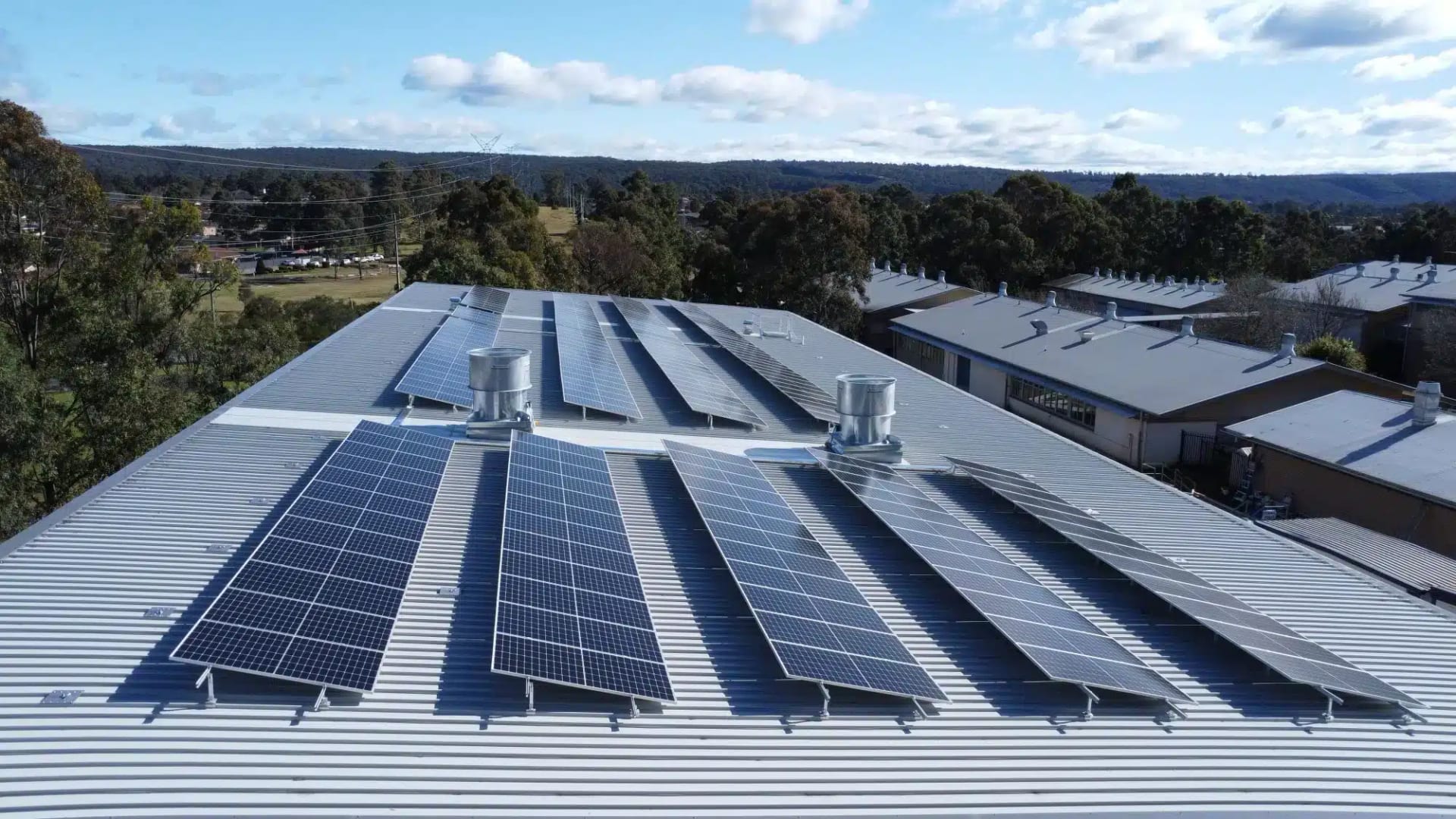
156kW Rooftop Solar Installation: AusDiagnostics, Mascot NSW
Project Overview
AusDiagnostics, a global molecular diagnostics manufacturer headquartered in Mascot, Sydney, partnered with Solar Galaxy to reduce the electricity costs of its purpose-built PC2 laboratory facility. Solar Galaxy designed and installed a 156kW rooftop solar system comprising 376 TW Solar 415W panels and 4 Sungrow inverters, cutting the site’s grid electricity consumption by 90% and delivering $50,000 or more in annual savings.
- System capacity: 156kW
- Solar panels: 376 x TW Solar 415W
- Inverters: 4 x Sungrow
- Annual electricity savings: $50,000+
- Projected lifetime savings: $1,500,000+
- Grid consumption reduction: 90%
- Installation type: Commercial rooftop
- Location: Mascot, Sydney NSW
What energy challenge did AusDiagnostics need to solve?
AusDiagnostics operates purpose-built PC2 molecular diagnostics laboratories in Mascot, NSW, where precision environmental controls, robotic testing equipment, and automated manufacturing systems sustain high electricity consumption throughout standard business hours. Solar Galaxy’s energy analysis confirmed the site’s daytime grid consumption profile aligned directly with what a rooftop solar system could generate and offset.
PC2 laboratory facilities carry energy demands that standard commercial buildings do not. Temperature and humidity regulation must remain constant to protect manufacturing integrity. Robotic diagnostic platforms and reagent production lines run continuously through trading hours. These loads produce a consistent daytime electricity draw that makes solar generation particularly effective: the system generates at or near peak output precisely when the facility’s consumption is highest, maximising the share of solar electricity used directly on-site rather than exported to the grid.
The Mascot site also presented a straightforward rooftop opportunity. The facility’s roof area was structurally suited to a large panel array, and unlike sites where competing roof equipment or shading constraints limit system size, the available surface at AusDiagnostics supported the 376-panel layout Solar Galaxy’s energy model specified. Solar Galaxy’s analysts modelled the site’s interval-specific grid consumption data against Sydney’s irradiance profile to confirm that 156kW of generation capacity would achieve the 90% grid consumption reduction the project delivered.
90% grid consumption reduction achieved — daytime laboratory loads align directly with peak solar generation
How did Solar Galaxy design the 156kW rooftop system?
Solar Galaxy designed the 156kW rooftop solar system for AusDiagnostics following a structural engineering assessment of the Mascot facility, which confirmed the roof’s load-bearing capacity and determined the optimal racking configuration for the 376-panel array. The assessment was completed before any design work proceeded, ensuring the installation method matched the specific structural characteristics of the building.
Rooftop solar design for an active manufacturing facility requires decisions that go beyond panel count and tilt angle. Solar Galaxy’s engineering team assessed the roof membrane type, drainage patterns, and existing plant and equipment to determine the racking layout that would support 376 panels across the available area without concentrating load on any single section of the roof structure. The team also confirmed that the mounting approach preserved the integrity of the roof membrane, protecting the building against water ingress for the life of the installation.
Solar Galaxy managed all regulatory approvals, grid connection applications, and compliance submissions on behalf of AusDiagnostics throughout the project. For a facility where laboratory operations run without interruption, the ability to hand that administrative load to Solar Galaxy’s project management team meant the AusDiagnostics facilities team remained focused on manufacturing operations rather than navigating network operator requirements. Construction was sequenced to avoid disruption to the active PC2 laboratories below the rooftop installation area.
What solar panels and inverters power the system?
Solar Galaxy is not affiliated with any specific panel or inverter manufacturer. The selection of TW Solar 415W panels and Sungrow inverters for the AusDiagnostics installation reflects an independent assessment of the site’s capacity requirements, available roof area, and long-term performance targets against the full range of CEC-approved commercial solar panel systems and inverters available in the Australian market.
The system uses 376 TW Solar 415W monocrystalline panels across the Mascot rooftop, delivering a combined peak output of 156kW. At 415W per panel, the array maximises generation output from the available roof space. Panel selection for a manufacturing facility prioritises consistent long-term output as much as day-one performance: a panel with a low annual degradation rate sustains the financial returns modelled at commissioning throughout the 25-year system lifetime, protecting the $1,500,000 in projected lifetime savings.
Four Sungrow inverters convert the DC electricity generated by the panels into the AC power the AusDiagnostics facility uses. Sungrow inverters are manufactured by one of the world’s largest inverter companies, with a strong commercial track record in Australian conditions. Distributing the system’s conversion capacity across 4 units rather than a single large inverter improves operational resilience: if one inverter requires servicing, the remaining 3 units continue generating while the issue is resolved, rather than bringing the entire 156kW system offline. All panels and inverters used in this installation are CEC-approved, meeting the Clean Energy Council’s requirements for grid connection approval by network operators and for eligibility under government incentive schemes including Large-scale Generation Certificates.
What is the environmental impact?
The AusDiagnostics rooftop solar system has reduced the Mascot facility’s grid electricity consumption by 90%, replacing the great majority of the site’s energy supply with clean solar generation. For a life sciences manufacturer whose products are used by hospitals and diagnostic laboratories across Australia, New Zealand, and the Asia-Pacific region, that scale of reduction supports the sustainability standards that institutional and government supply chains increasingly require.
Life sciences and diagnostics manufacturers face growing pressure from hospital procurement frameworks to demonstrate Scope 2 emissions performance. Scope 2 emissions are those produced by the generation of purchased electricity: by sourcing 90% of site electricity from solar rather than the NSW grid, AusDiagnostics has materially reduced its Scope 2 emissions footprint. This reduction is verifiable, site-specific, and backed by LGC generation records, giving the company a documented renewable energy position to present to institutional customers and supply chain auditors.
Over a 25-year system lifetime, the cumulative volume of grid electricity displaced by the AusDiagnostics installation represents a sustained reduction in fossil fuel-generated power drawn from the NSW grid. Each year the system operates, 90% of the facility’s electricity demand is met without grid purchase, compounding the emissions benefit across the full operational lifespan of the installation.
Key Performance Indicators
90%
Grid consumption reduction
$50K+
Annual savings
$1.5M+
Lifetime savings
376
TW Solar 415W panels
Why did AusDiagnostics choose Solar Galaxy?
AusDiagnostics selected Solar Galaxy because the Mascot facility’s active PC2 laboratory operations required an installer capable of managing rooftop construction with no disruption to precision manufacturing processes below. Solar Galaxy’s end-to-end delivery model covered every stage: energy modelling, structural engineering assessment, system design, product procurement, installation, and post-commissioning monitoring, all managed by a single team.
Solar Galaxy’s installers are accredited through Solar Accreditation Australia (SAA), the national body that sets and audits installer standards for grid-connected solar in Australia. Solar Galaxy holds REC Certified Solar Professional status, reflecting completion of advanced product and installation training. All products installed in this system are CEC-approved, meeting the Clean Energy Council’s performance and safety standards required for grid connection and government incentive scheme eligibility. For a facility that supplies diagnostic equipment to government hospitals and accredited laboratories, working with an installer that meets these standards is not incidental: it is a procurement requirement. Solar Galaxy has applied the same accreditation standards across comparable large-scale life sciences projects, including a 290kW rooftop solar installation for Fresenius Medical Care, Australia’s leading provider of kidney dialysis care.
The panel and inverter selection for this project was made through Solar Galaxy’s independent product assessment process, without commercial arrangements with any manufacturer. TW Solar panels and Sungrow inverters were chosen because they met the site’s capacity requirements, carried CEC approval, and offered the long-term performance profile the energy model required. Contact Solar Galaxy for a free site inspection and feasibility report tailored to your facility’s energy consumption and roof profile.
What financial results has this system delivered?
The 156kW rooftop solar system at AusDiagnostics delivers $50,000 or more in annual electricity savings for the Mascot facility, with lifetime savings projected to exceed $1,500,000. The 90% reduction in grid consumption means the facility now sources the great majority of its daytime energy requirements directly from solar generation, purchasing from the grid only when output falls short of site demand.
Commercial electricity pricing in NSW makes a 90% reduction in grid consumption financially significant for a facility of this type. Manufacturing sites with sustained daytime loads face both energy charges (the cost per kWh consumed) and demand charges (the peak kW drawn in each billing interval). A 156kW solar system generating at full output during business hours directly reduces both: energy charges fall because grid purchases fall, and demand charges fall because peak grid draw decreases when solar is covering the majority of the load.
At 156kW, the AusDiagnostics system qualifies for Large-scale Generation Certificates (LGCs) under Australia’s Renewable Energy Target. LGCs are created for each megawatt-hour of eligible renewable electricity generated above the baseline set under the scheme, and represent a tradeable financial instrument for the system owner. Solar Galaxy manages LGC creation and trading in-house, meaning the certificate revenue flows directly to the client rather than to a third-party broker who would otherwise clip a margin from the transaction. For a full overview of available incentives for NSW businesses, see commercial solar rebates in NSW.
Payback period and return on investment figures vary based on the site’s electricity tariff structure, consumption patterns, and applicable government incentives at the time of installation. Contact Solar Galaxy for a site-specific commercial solar feasibility report that models these figures against your actual interval data.
Ongoing Monitoring & System Performance
Solar Galaxy’s in-house monitoring team tracks the AusDiagnostics system’s output against the energy model benchmarks set during the feasibility assessment. Where performance deviates from expected levels, the monitoring team identifies the cause and alerts the client before it affects savings targets. That ongoing accountability is backed by a workmanship warranty above the industry standard, with Solar Galaxy remaining the single point of contact for any warranty or performance question for the lifetime of the system.
Frequently Asked Questions About Commercial Rooftop Solar Installations
Ready to find out what a commercial rooftop solar system could deliver for your facility? Solar Galaxy provides a free site inspection and compares all system configurations to find the right fit for your energy usage and roof profile. Request a free quote today.
How much can a commercial rooftop solar system reduce electricity costs?
The reduction depends on system size, site consumption volume, and the facility's electricity tariff structure. The 156kW rooftop solar system at AusDiagnostics achieved a 90% reduction in grid electricity consumption and delivers $50,000 or more in annual savings. A site-specific feasibility assessment is the only reliable way to model savings for your facility. Contact Solar Galaxy for a report based on your actual interval data.
What size rooftop solar system does a commercial manufacturing facility need?
System size is determined by the facility's electricity consumption profile, available roof area, and the proportion of daytime load the owner wants to offset. Manufacturing facilities with sustained daytime loads, such as those running production equipment, environmental controls, and robotics during business hours, are well suited to large commercial rooftop systems. Solar Galaxy's energy analysts model interval-specific consumption data to specify the right system size for each site.
What government incentives apply to commercial rooftop solar in Australia?
Commercial solar systems at or above 100kW qualify for Large-scale Generation Certificates (LGCs) under Australia's Renewable Energy Target. LGCs are created for each MWh of eligible renewable electricity generated and can be traded to generate ongoing revenue. Systems under 100kW qualify for Small-scale Technology Certificates (STCs) at the point of installation. Incentive eligibility and certificate values change over time. Check current eligibility with your installer before making investment decisions based on certificate revenue.
How long does a large commercial rooftop solar installation take?
The physical installation of a commercial rooftop solar system typically takes days to a few weeks, depending on system size and roof accessibility. The total project timeline is longer because it includes energy modelling, structural engineering assessment, product procurement, council applications, and grid connection approval. Solar Galaxy manages all pre-installation stages on behalf of the client, reducing the administrative burden on the facility's team throughout the process.
Can rooftop solar be installed without disrupting active manufacturing operations?
A rooftop solar installation does not require any shutdown of manufacturing operations below, provided the structural assessment confirms the roof is suitable and the installation team sequences construction to avoid disruption to sensitive areas. Solar Galaxy's project management team coordinates installation around the facility's operational requirements. The AusDiagnostics installation at Mascot was completed without disruption to the active PC2 laboratory operations running throughout the construction period.
Other Case Studies
Explore more success stories and discover how we’ve helped other clients achieve their solar energy goals.

10.53kw Solar System Installation in Clovelly, NSW
10.53 kW System
27 x 390w Qcells G9+ Panels
1 x Sungrow 8 kW inverter

100kW Solar and 280kW Battery Storage Installation: Coppertree Farms
99.5 kW Solar and 280 kWh battery
199 x 500W Risen Panels
2 x Sungrow 50 kW Commercial Inverters

24.3kw Commercial Solar System Installation at Not Just Curries, Harris Park, NSW
24.3kW
54 x 450W Longi panels
1x Fronius Symo 20kw Inverter

290kW Commercial Solar Installation for Fresenius Medical Care Australia (Sydney)
System Size: 290kW
Solar Panels: 537 × Risen 540W modules
Inverters: 4 × Sungrow commercial inverters
297kW Commercial Solar Carport Installation: Mortdale Plaza, Sydney
System Size: 297kW
Solar Panels: 625 × SunPower 475W
Inverters: 2 × SMA

6.6kw Solar System Installation in Cromer, NSW
6.6 kW installed in Cromer NSW 2099
17 x 390w Hyundai Solar Panels
1 x Sungrow 5 kW inverter

66.43kw Commercial Solar System installed in Evaton Trophies at Mt Kuring Gai NSW
66.43 KW
146 x 455W Longi Panels
1x Sungrow 50 kW Inverter